|
|
 |
RESPONDER
> news |
|
 |
News on SCP and Growth
| Call for Papers for a Special Issue of the Journal of Consumer Policy on "System Perspectives on Sustainable Consumption Policies" |
[2015-01-30] |
The RESPONDER consortium has published a call for papers for a special issue in the Journal of Consumer Policy on the topic "System Perspectives on Sustainable Consumption Policies". With the aim to introduce a systems thinking view to the scientific debate on sustainable consumption policies, we are looking for contributions that (i) follow a sound understanding of systems thinking and sustainable consumption; (ii) address a specific consumption area such as food, housing, mobility in order to provide substantial insights and recommendations; (iii) present conceptual and/or empirical results that take key elements of systems thinking (such as feedback cycles, systems dynamics, system boundaries) into account; and (iv) provide conclusions, e.g. for political agenda setting, design and implementation of policy instruments and policy mixes or governance mechanisms.
The deadline for submission of papers is September 30th, 2015. |
|
>> More
|
 |
| New Book Published on Degrowth |
[2014-11-24] |
In contemporary times, stagnation, rapid
impoverishment, rising inequalities and socio-ecological disasters constitute
leading notions in economic discourse. This book argues that growth is the
dominant reason behind unsustainable developments and thus offers a comprehensive
coverage of the main topics and major challenges of degrowth. In addition, it
offers a set of keywords useful for intervening in current political debates
and for bringing about concrete degrowth-inspired proposals at different levels. |
|
>> More
|
|
| New OECD Publication on Green Growth Indicators 2014 |
[2014-07-07] |
In light of its Green Growth Strategy, OECD supports countries in fostering economic
growth and development while ensuring that natural assets continue to provide
the resources and environmental services on which well-being relies. In this
context, OECD accentuates the importance to understand and develop determinants
of green growth and to establish indicators to monitor progress and gauge
results. This new publication on Green Growth Indicators 2014 updates the OECD
framework for monitoring progress towards green growth and presents a selection
of updated indicators that illustrate the progress that OECD countries have
made since the 1990s. |
|
>> More
|
|
| Online Petition: Endless Economic Growth is not Sustainable on a Finite Planet |
[2014-06-30] |
Major environmental problems that undermine human well-being – such as climate change, various types of pollution and the destruction of ecosystems – are largely driven by rising consumption that increases the use of natural resources. However, current economies are dependent on growth and minimal research is conducted on growth dependence. This online petition intends to secure funding for research on growth dependence and encourage thinking about the many complexities that need to be addressed in non-growing economies. |
|
>> More
|
|
| Cities & Regions as Catalysts for Smart & Sustainable Innovation, November 3-4 2014, Copenhagen, Denmark |
[2014-05-26] |
The debate revolving around the concept of ‘Green
Economy’ is becoming increasingly important with cities being of focal interest
as they resemble ‘hot beds’ of environmental and social problems. In this
context, cities are considered to take up a vital role to function as catalysts
for the development of new sustainable solutions to transport, water, food,
energy, waste and lifestyle problems. Sustainable Innovation 2014 seeks to
provide a platform to discuss the opportunities and challenges related to the
role of cities and regions in catalysing, facilitating and stimulating
sustainable innovations. Therefore, the event will create a unique space for
learning, networking and thinking with delegates attending from large
companies, SMEs, as well as academia, government and non-governmental
organisations. |
|
>> More
|
|
| Conference "Mapping Environmental Justice" on 19 March 2014 |
[2014-03-06] |
The European Environmental Bureau, United Nations Environment Program and Environmental Justice Organisations, Liabilities and Trade project (EJOLT) have the pleasure to invite you to the UNEP Brussels Office for a conference and debate on environmental justice. On March 19, experts will shed light on how environmental justice is seen in the European Union and the United Nations. Others will bring cases of landgrabbing, shipbreaking and oil liabilities. And a new Global Atlas of Environmental Justice will be launched. The conference ends with a panel debate and your questions.
The Atlas of Environmental Justice is a practical and intuitive online platform that maps a thousand environmental conflicts in the world. It allows searching and filtering across around 100 fields, as well as browsing by commodity, company, and type of conflict. With one click you will get, for example, a global overview of the world’s nuclear, waste or water conflicts. Or the 15 places where local groups have an issue with the Vale mining company. Click on any point and you will get all background information from actors and a conflict description to outcome and sources. Any map you create using the search and filter can be embedded on your webpage or shared with friends on facebook. More info on the Atlas is here
In short, this conference promises to be of practical use. It will highlight the gaps in international legislation and policies on environmental justice. It will exemplify such gaps in three specific cases: landgrabbing, shipbreaking and the case where Earth Rights Action from Nigeria helped to bring the landmark case against Shell in the Hague. And it will introduce a very practical tool for researchers, policymakers, journalists and activists: the Atlas of Environmental Justice.
Wednesday 19 March from 9 until 13h in UNEP Brussels Office
Interested? Then go to Program or straight to Registration
Suggested hashtag for Twitter users during & after the event: #environmentaljustice |
|
|
|
| RESPONDER conference "Austerity, Stimulus or Post-growth for Europe?" - only 10 days left for registering |
[2014-03-02] |
The closing conference of the RESPONDER project will take place on 21 March 2014 at the European Parliament in Brussels. It will revisit the propositions of Sicco Mansholt, former President of the European Commission, to explore the complex relation between economic growth and sustainability and its meaning for the European crisis. The participants will discuss hot topics concerning growth and sustainable consumption, Europe and the crisis, and welfare with(out) growth in Europe. Online registration will be open until 12 March 2014. |
|
>> More
|
|
| Report published on “Smart Cities” in the EU |
[2014-02-27] |
The report aims to provide
background information and advice on ‘Smart Cities’ in the EU and explains how
current mechanisms are functioning. It seeks to establish a working definition of
a ‘Smart City’ and attempts to map cities accordingly. The study reveals that ‘Smart
City’ objectives should be more explicit, well defined and clearly aligned to
city development, innovation plans and the Europe 2020 targets in order to be
successful. |
|
>> More
|
|
| Social Innovation and the Environment |
[2014-02-20] |
The latest In-depth Report
from Science for Environment Policy explores grassroots innovations focussing
on social and environmental improvements. From urban beekeeping in Copenhagen
to pedal-powered distribution in Paris and community farming in London, social
innovation can help create new jobs, improve social inclusivity and strengthen
local economies, whilst delivering benefits for nature, air quality and climate
change mitigation. The report presents case studies of social innovation as
well as research into frameworks and evaluation methods which can help
policymakers understand social innovation and its environmental implications. |
|
>> More
|
|
| CONSENSUS secures EPA funding to further its innovative research on sustainable consumption |
[2014-02-13] |
CONSENSUS has been awarded
funding by the Irish EPA to further its innovative research on sustainable
household consumption. CONSENSUS is the first large-scale, all-island research
project on sustainable consumption in Irish households. A core aspect of upcoming
research includes In-Home Living Labs. This will involve ethnographic research
within households where novel socio-technical innovations for more sustainable
food and water consumption practices will be tested and evaluated. CONSENSUS is
collaborating with public sector bodies, NGO’s, and corporate sector partners
to identify households, prototype devices and enhance the impact of the Living
Labs research and encourage interested parties to get in touch. |
|
>> More
|
|
| New article published on grassroots concepts and sustainability |
[2014-02-06] |
The paper elaborates on a wide
array of concepts and slogans related to environmental inequities and
sustainability. It comprises concepts such as environmental justice, ecological
debt, popular epidemiology, environmental racism, climate justice and many
more. It examines how activists have coined these notions and built demands
around them, and how academic research has in turn further applied them and
supplied other related concepts, working in a mutually reinforcing way with Environmental
Justice Organisations. |
|
>> More
|
|
| GGKP Launches New Web Platform to Accelerate Green Economy Transition |
[2014-01-28] |
This new knowledge sharing
platform aims to respond to an increasing demand from both policy makers and
the public for information on ways to achieve sustainable economic growth. It
provides useful features such as an e-library with over 600 relevant technical
and policy resources, a global database of green growth projects, an insights
blog offering details and analysis on the newest innovations, up to date
country information, a collection of over 25 sector and theme pages and updates
on green growth events and recently released research, tools and data. |
|
>> More
|
|
| RESPONDER final conference: Austerity, Stimulus or Post-growth for Europe? Revisiting Sicco Mansholt's Vision, Brussels, Belgium, March 21 2014 |
[2014-01-27] |
This final conference revisits
the propositions of Sicco Mansholt, former President of the European Commission,
to explore the complex relation between economic growth and sustainability and
its meaning for the European crisis. The participants will discuss hot topics concerning
growth and sustainable consumption, Europe and the crisis, and welfare
with(out) growth in Europe. |
|
>> More
|
|
| New article published on developing alternatives to GDP measurement |
[2014-01-20] |
The article titled "Time
to leave GDP behind" has been published in Nature and comprehends a substantial critique of GDP as the
dominant factor determining human development. Hence it attempts to clarify that
we need new, more integrated measures of sustainable human well-being and that
currently the chances have never been better to introduce alternative and more
applicable ways of measuring future developments. |
|
>> More
|
|
| 2nd International Conference on ICT for Sustainability will be held in Stockholm, Sweden 24-27 August 2014 |
[2014-01-13] |
The theme of the 2014
conference is “ICT and transformational change”. Sustainable development needs
transformational changes both in technology and in our patterns of production
and consumption. This conference continues to explore and shape the role of ICT
in this process, including the assessment of both negative and positive impacts
of ICT on sustainability. |
|
>> More
|
|
| New article published on sustainable production, consumption, and livelihoods |
[2013-12-19] |
This introduction to a Journal
of Cleaner Production Special Volume maps the emerging field of sustainable production and
consumption (SPaC) systems research and illustrates the multiple perspectives
on how to analyse the present production and consumption system and how to
conceptualise (systemic) change. It considers how research over the last 20 years
has revealed a lot of the mechanisms and lock-ins of unsustainable consumerist
lifestyles and production patterns, and the barriers to systemic change. |
|
>> More
|
|
| New article published on different conceptual responses to the system crisis |
[2013-12-16] |
In light of the financial
crisis and economic uncertainties, a number of new approaches have been
introduced such as green new deal, green growth and the great transition. These
responses have in common that they all present a large number of policy
proposals for ways in which to solve the current crises and achieve a
sustainable economy. This article provides a mapping of a selection of such
responses and an analysis of their content. The analysis combines discourse
theory and narrative analysis and investigates discourses by studying the
narratives they produce. The study thus contributes to the long line of
analyses on discourses on sustainable economy: empirically, by investigating
and analysing a number of macroeconomic proposals for solving the system
crisis, and theoretically, by elaborating on the concept of narrative dynamics
in relation to persuasive strength in political decision-making. |
|
>> More
|
|
| Report on “A post-growth society for the 21st century” |
[2013-11-21] |
The IDDRI at Sciences Po Paris
recently published a report considering
the feasibility to prosper without growth. The report seeks to analyse the
future of growth and how future societies can prosper within a low or zero growth
context. It draws its conclusion from economic literature and structured
seminars which brought together practitioners, policy makers and experts carrying
out modelling exercises to investigate the links between the energy-climate
nexus and the economy. |
|
>> More
|
|
| Call for Papers: Fourth International Conference on Degrowth for Ecological Sustainability and Social Equity, 2nd-6th September 2014, Leipzig, Germany |
[2013-11-12] |
The Call for Papers is part of
the upcoming conference seeking to principally explore three topical areas,
namely ‘Organizing a Degrowth Society’,
‘Building a social and ecological economy’,
and ‘Living conviviality’. Contributors are asked to
elaborate on issues related to these three broad fields of study. The Call for
Papers aims at reflecting, substantiating, and developing further scholarly
work on degrowth and therefore persons wishing to contribute should submit proposals until December 31st 2013, and papers
and abstracts until January 31st 2014. |
|
>> More
|
|
| New Special Issue on Sustainable Food Consumption |
[2013-11-11] |
A new issue dealing with current trends, policy
approaches, and future scenarios of sustainable food consumption has been published in the e-journal Sustainability: Science, Practice, & Policy. It contemplates
the complexities of contemporary food production and consumption systems as a
challenging factor for sustainability policy-making. |
|
>> More
|
|
| Towards a Sustainable Europe: Experts Call for Stronger Joint Efforts to Stimulate Systemic Innovations |
[2013-10-24] |
Technological innovations are commonly seen as decisive for overcoming environmental exploitation and degradation. That this view is too narrow was the common sense of an encounter of Europe’s leading sustainability experts which took place in Brussels from 10-11 October 2013. The researchers stressed that only the interplay with social innovations can lead to a significant step towards a sustainable society. The experts’ gathering was attended by 38 sustainability experts from 12 countries. It was part of the European project RESPONDER, which enables scientists and policy makers to exchange experiences and knowledge with regard to sustainable consumption issues. |
|
>> More
|
|
| Highlights of the First International Conference on Global Food Security |
[2013-10-17] |
Although
already conducted the First International Conference on Global Food Security
would like to invite interested people to access their high quality webcasts of
selected presentations from the conference. The conference brought together
over 600 researchers from key disciplines to discuss global food security in
light of the increasing global population. For those who are interested in
registering the material will be available for free from 4th November 2013 onwards. |
|
>> More
|
|
| Report on sustainable food consumption |
[2013-09-11] |
The report identifies and examines three
key areas of sustainable consumption, namely the principles of a healthy and
sustainable diet, consumer behaviour, and sustainable consumption and growth.
It has been published by the Department for Environment, Food and Rural affairs
(DEFRA) of the United Kingdom based on ideas and recommendations of ‘The
Green Food Project’ written in 2012. Latter investigated the roles that diet
and consumption play in the sustainability of the whole food system. The work
is based on the departments premise to make the food and farming industry more
competitive while protecting the environment. Therefore it agreed to continue working
with the same approach taken in the ‘Green Food Project’ and to collaboratively
work with a range of stakeholders. |
|
>> More
|
|
| Call for papers: Special issue on "Framing Degrowth: from diagnosis to development alternatives" |
[2013-09-10] |
The degrowth movement has emerged in the last decade in some European
countries. It is a movement built around a critique of the growth economy,
which draws strongly on the “limits to growth” and strong sustainability
debates of the 1970s. The underlying premise is that continuous economic growth
is ecologically unsound, economically unsustainable, and it is no longer
improving social welfare and happiness. This special issue aims at articulating
the degrowth critique, proposal and movement through a framework composed of
four different axes: critique to growth societies, degrowth policies, actors
and strategies for degrowth, and alternative world-visions. |
|
>> More
|
|
| 80% of Europeans are concerned about the environmental impact of products |
[2013-07-10] |
According to a new survey, most Europeans would be
prepared to change their purchasing habits and buy more
environmentally-friendly products, but many feel they lack information and
distrust manufacturers' environmental claims. The survey on the "Attitudes
of Europeans towards building the single market for green products"
indicates that more than three-quarters of respondents are willing to pay more
for environmentally-friendly products if they were confident that the products
are truly environmentally-friendly (77%). However, only slightly more than half
of EU citizens feel informed (55%) about the environmental impacts of the
products they buy and use. |
|
>> More
|
|
| European Commission publishes service contract on cloud computing |
[2013-07-09] |
The European Commission published a service
contract attributing the title ‘Definition of a research and innovation policy leveraging cloud computing and
IoT combination’. The final date for the receipt of
tenders or requests to participate is August 23rd 2013 at 16:00. |
|
>> More
|
|
| Sustainable Housing Experts: “Building Sector Should No Longer Be Seen as Engine of Economic Growth” |
[2013-07-08] |
Why are houses and apartments in many European countries empty, whilst in other parts people cannot afford to buy or rent a living space? Because the building sector is mainly used as an engine to boost economic growth, say Europe’s leading experts on sustainable housing. From 6-7 June 2013 European housing experts convened in Barcelona to discuss the future of housing in the workshop “Sustainable Housing in a Post-Growth Europe”. More than 50 professionals from 15 European countries took part in the event and now they demand a paradigm shift: The building sector should no longer be seen as an engine of economic growth, but instead better fulfil its basic function, i.e. provide liveable and affordable space for the Europeans to reside. |
|
>> More
|
|
| Expressions of Interest: RESPONDER Final Conference in Brussels, April 2014 |
[2013-07-02] |
The ICTA UAB is organizing the two‐day final conference in Brussels in
April 2014 (tentative date 3‐4 April). The ICTA UAB can give a subcontract for a
tentative maximum of 29,000 € to a local organizer of the conference in
Brussels which has well-established contacts to policy makers and which 1) will
secure an appropriate location for no more than 80 participants, who will break
out into smaller groups, 2) will pay for travel costs and lodging for 5 plenary
speakers chosen in agreement with ICTA‐UAB and the coordinators of RESPONDER,
3) will pay for a professional facilitator during the conference, chosen in agreement
with ICTA UAB, 4) will provide the catering for participants, 5) will ensure
together with ICTA UAB and the coordinators of RESPONDER the running of the
conference, and 6) will make a substantive contribution to the scientific and
policy contents, and civil society engagement in the conference. |
|
>> More
|
|
| Sustainable consumption in the UK: A selection of case studies |
[2013-06-26] |
The report presents case studies of best
practice in achieving sustainable consumption in the UK. These case studies
exemplify ways in which people can be helped, encouraged or compelled to live
more sustainably, either directly or indirectly. The first set of four case
studies relate to initiatives led by, or involving, government to restrict or
inform consumers’ product choice around a particular class of product. The
second set of case studies focuses on the role of large-scale public campaigns
to raise awareness of sustainable livelihood issues. The third set of case
studies relate to capacity-building initiatives. The final case studies show
how two different actors are leading sustainable consumption initiatives in the
UK. |
|
>> More
|
|
| RESPONDER Invitation: Linking Policy and Science for Sustainable Innovation, 10-11 October 2013, Brussels |
[2013-06-25] |
We have the pleasure to invite you to a 1.5 day journey to explore emerging issues around the topic of innovation:
Linking Policy and Science for Sustainable Innovation
3rd EU Dialogue on Sustainable Consumption and Economic Growth
taking place
10-11 October 2013
in Brussels
A selected group of policy makers and researchers from across Europe will come together to discuss areas of contention between sustainable consumption and economic growth from the perspective of innovation. The overall aim is to exchange knowledge on how to deal with these contentions and arrive at a tangible impetus for effective policy development, while also pointing to areas that still require research. In particular, the debate will focus around three themes:
- Technological Innovations and Sustainability
- Innovation in the Context of Growth & De-Growth
- Social Innovation and Sustainable Consumption/ Production
Given your engagement with our central topic of innovation and/or sustainable consumption and production, we would really value your insights and hope very much that you will be able to join us.
Please find a briefing note for this event on the following website: http://www.scp-responder.eu/events/eu_dialogue
Registration will be open until 30 July 2013. Registration is free of charge. Please note that the number of participants is limited. Hence, we kindly ask you to register as soon as possible online via http://www.scp-responder.eu/events/eu_dialogue.
Poster Walk
Finally, we would like to extend the invitation and give you the opportunity to present your projects, theses, results, questions, etc. on a poster. The poster walk will take place on 10 October following the lunch break. Participants are requested to be present at their designated posters during the poster session to answer any questions. If you would like to present a poster at the conference, we ask you to send an abstract by August 31st. You will be notified by September 7th, whether your poster is accepted and provided with further instructions at that time.
For any further questions about the event, please do not hesitate to contact us at eudialogue@responder.eu. We look forward to hearing from you!
With kind regards, on behalf of the RESPONDER Consortium,
Jill Jäger and Fritz Hinterberger |
|
>> More
|
|
| The Sharing Economy in the UK |
[2013-06-25] |
The research report, based on representative UK consumer research, is
the first in a series reporting on the state of the Sharing Economy. The global
Sharing Economy is a new and emerging market already estimated to be worth over
£330 billion p.a. In the UK it is valued at £22.4 billion which is 1.3% of GDP
and predicted to rise to 15% within 5 years. Economists and academics have
predicted that this new sector will have the biggest impact on society since
the Industrial Revolution. UK sharers saved or made an average of £416.16 with
some sharers gaining as much as £5,000 a year. Based on the results of the
report, the adult population of the UK consumer earnings totalled £4.6 billion
in the past year. For comparison, US sharers are estimated to make $3.5 billion
in 2013, with growth exceeding 25%. |
|
>> More
|
|
| Launching Event of URBACT Thematic Reports, 18th June 2013, Brussels |
[2013-06-18] |
URBACT with the support of Directorate-General
for Regional and Urban Policy of the European Commission is organising a
launching event of a series of six new URBACT thematic reports "Cities of
Tomorrow: Action Today". Published as a result of URBACT capitalisation
process these reports focus on key urban challenges. The launching event will
take place in Brussels in the European Commission Albert Borschette Conference
Centre on Tuesday 18 June 2013, 11:00-14:00. Participants are invited to debate
the big issues facing European cities with experts and take the opportunity to
submit questions. |
|
>> More
|
|
| Greening Household Behaviour: Overview from the 2011 Survey |
[2013-06-13] |
Developing growth strategies that
promote greener lifestyles requires a good understanding of the factors that
affect people's behaviour towards the environment. Recent OECD work based on
periodic surveys of more than 10 000 households across a number of countries
and areas represents a breakthrough by providing a common framework to collect
unique empirical evidence for better policy design. This publication presents a
data overview of the most recent round of the survey implemented in five areas
(energy, food, transport, waste, and water) and eleven countries: Australia,
Canada, Chile, France, Israel, Japan, Korea, the Netherlands, Spain, Sweden and
Switzerland. The new survey confirms the importance of providing the right
economic incentives for influencing our decisions. The findings indicate that
"soft" measures such as labelling and public information campaigns
also have a significant complementary role to play. |
|
>> More
|
|
| UNEP Releases Paper on Reducing Food Waste |
[2013-06-12] |
The UN Environment Programme (UNEP) has released
a working paper on reducing food waste. The paper draws distinctions
between food waste in developed and developing countries, indicating that in
Australia, Canada, Europe, and the US, food waste occurs at the consumption
stage. In contrast, food waste in developing countries occurs close to the
farm, after harvest and storage. It further contends that reducing food
waste can make significant progress toward a sustainable food future. It
proposes several ways to reduce food loss, including: facilitating food
redistribution or donation; using evaporative coolers in places where
refrigeration is unavailable; introducing hermetically sealed plastic storage
bags for crops; or changing food date labels to reduce consumer confusion about
when food is unsafe. |
|
>> More
|
|
| Taking Stock: Current Research, Policy & Practice in ‘Eco-City’ Indicators, Standards and Frameworks, 28th June 2013, London |
[2013-06-04] |
This first of three workshops
hosted in the UK in 2013-2014 will review recent developments concerning urban
sustainability indicators and frameworks across Britain. It will consider
recent research (from different academic perspectives) on the conceptualisation
and application of indicators and frameworks, and analyse current policy
initiatives as well as practical developments. An important aim of the workshop
is to bring together researchers, policy specialists and practitioners with a
view to building research capacity and encourage networking. The workshop is
jointly hosted by University College London (Bartlett School of Planning) and
the University of Westminster (International Eco-Cities Initiative), as part of
the Leverhulme International Network Tomorrow’s City Today. |
|
>> More
|
|
| The InContext Final Conference & Informed Cities Forum 2013, 6-7 June 2013, Berlin, Germany |
[2013-05-30] |
The Informed Cities Forum 2013 & InContext
Conference will be the meeting place for local government and community
representatives, researchers and other actors interested in exploring how we
can create space for change and move towards better places, stronger communities
and resilient societies. The conference will take place in the tak, in the heart of Berlin, the city
that has come to symbolize change and urban transformation. Brimming with
bottom-up initiatives and grassroots creativity, Berlin is a city that lives
and breathes transformation and can act as a laboratory for understanding
societal change. |
|
>> More
|
|
| Tim Jackson: “Policy must force finance markets to take a longer term view” |
[2013-05-17] |
The transition to a sustainable economy cannot be delivered without transforming the finance system away from one which is dominated by short term speculation and asset bubbles into one that lends far more to the real economy, properly integrates ecological risks into long term investment and helps savers understand how their money is allocated by banks and pension funds. This was the view of a gathering of EU sustainable finance experts at the RESPONDER workshop on "Changing the Finance System to enable the Transition to a Sustainable Economy" held in Brussels on 14-15 May 2013. |
|
>> More
|
|
| Special Issue on Degrowth in Environmental Values |
[2013-05-14] |
This volume of “Environmental Values” introduces
some of the latest thinking and key areas of debate that now define the
field of degrowth. Collectively, this special issue develops a range of new and
innovative perspectives on questions of degrowth. Crucially, these perspectives
are offered both by those who are closely associated with the degrowth movement
and by those who are not. Ultimately, these papers help to
realise the complex issues and questions that are likely to confront a world
that no longer wishes to pursue growth at all costs. |
|
>> More
|
|
| Sustainable Food Consumption: Experts Demand Ambitious Governance Reforms in the EU |
[2013-05-07] |
Experts promote transition towards a sustainable food system // Current food consumption and production patterns cause severe impacts on health and environment // Opposing Food Waste: Industrialized countries’ food waste would be sufficient to feed the world’s malnourished people // Knowledge brokerage consortium RESPONDER stresses the need of strong governance structures and actions
On 18-19 April, more than 50 specialists from 15 countries met in Lisbon (Portugal) to discuss current food consumption trends and necessary reforms in order to achieve a sustainable food system. Identified hotspots that call for interventions are the damages to environment that are caused within the food chain and health issues. |
|
>> More
|
|
| Sustainable Transport Action Network Launched |
[2013-05-01] |
The UN Division for Sustainable Development
(DSD) has reported on the launch of the Sustainable Transport Action Network,
noting that sustainable transport provides access to goods and services in
support of economic and social development while minimizing negative
environmental, social and economic impacts of the transport sector. The April
issue of the DSD newsletter “Sustainable Development in Action” highlights the
importance of sustainable transport as an enabler of development, and
underlines that transport is one of UN Secretary-General Ban Ki-moon's six
building blocks for sustainable development in his five-year action agenda. The
UN Conference on Sustainable Development also cited the centrality of transport
and mobility to sustainable development. The Action Network integrates various
initiatives including the Voluntary Commitments on sustainable transport made
at Rio+20. Other initiatives may register support for the Network on
DESA's Sustainable Development Knowledge Platform (SDKP). |
|
>> More
|
|
| Call for Papers: International Symposium, Systems Thinking for a Sustainable Economy |
[2013-04-30] |
The
scientific non-profit organization Business
Systems Laboratory is glad to announce the Call for Papers of the Business Systems Laboratory 2nd International
Symposium: Systems Thinking
for a Sustainable Economy. Advancements in Economic and Managerial Theory and
Practice that will be held in Rome at the Universitas
Mercatorum on January 23 and 24,
2014. The Partners of the event
are The World Organisation for Systems
and Cybernetics (WOSC), the Research
Institute for Managing Sustainability (Vienna University of Economics
and Business), the Systems Design and
Complexity Management Alliance (SDCM) and the European Evaluation Society (TWG – Evaluating Sustainable Development).
Among the publishing opportunities for the best selected papers presented at
the event will be three special issues of the following scientific
journals: Business Systems Review, Sinergie and the Journal of Organisational
Transformation & Social Change. |
|
>> More
|
|
| Food losses and waste in the context of sustainable food systems |
[2013-04-24] |
The UN Committee on World Food Security (CFS) requested
the High Level Panel of Experts
for Food Security and Nutrition (HLPE), to undertake a
study on ‘Food losses and waste in the context of sustainable food systems’ to
be presented to the Plenary in 2014. As part of its report elaboration process,
the HLPE is now launching an e-consultation to seek views, public feedback
and comments, on the
pertinence and interconnections of some key questions that the report proposes to
address. The issue of food losses and waste has
recently been given high visibility. According to FAO (2011), almost one-third of food
produced for human consumption – approximately 1.3 billion tonnes per year is either lost or wasted. Their global reduction is now presented as essential to
improve food security and to reduce the environmental footprint of food systems. |
|
>> More
|
|
| Pre-launch of SCP Clearinghouse |
[2013-04-23] |
The
United Nations Environment Programme has pre-launched the online Global SCP Clearinghouse. The Global SCP Clearinghouse is meant to offer a unique one-stop hub dedicated to advancing
the implementation of Sustainable Consumption and Production (SCP) worldwide.
Through knowledge sharing, cooperation and participation tools, all
stakeholders – governments, UN agencies and other international organizations,
the business sector and civil society – will be offered the opportunity to: Participate and contribute to regional and
thematic "communities of practice", share and find information on SCP, build networks and identify partners, and strengthen their capacities. The objective of the pre-launch is
to engage the global SCP community
and populate the database of the Global SCP Clearinghouse before it goes live
in May. |
|
>> More
|
|
| Hidden impacts: How Europe's resource overconsumption promotes global land conflicts |
[2013-03-26] |
This report examines the
inter-linkages between our material use and related land requirements and, through
demonstrating this link, highlights the very urgent need to scale down our
excessive consumption of resources in the interests of maintaining the
regenerative capacity of the biosphere, as well as conserving resources for
future generations. To reduce Europe’s land footprint, it is essential that we
drastically decrease our overall consumption, including changes in our
consumption of items such as meat, as well as rethink policies that drive
resource depletion in other parts of the world. |
|
>> More
|
|
| Sustainable Mobility for European Cities: Experts Sketch the Future |
[2013-03-25] |
Urban mobility is crucial for making Europe’s cities more sustainable. The key for improvement is concerted and goal-directed planning, say Europe’s leading mobility experts. It is important that the cities develop long-term goals for their respective mobility future.
Last week, more than 66 professionals from 16 European countries discussed in Bratislava the trends, barriers and approaches for sustainable mobility in European cities. The experts agreed that it is necessary to focus on clever combinations of technological and infrastructural solutions with measures to stimulate changes on the demand side. In a nutshell, sustainable urban mobility in the future has to opt for clean technologies, smart infrastructures and to favour the change of modal split towards more walking, cycling and public transport. |
|
>> More
|
|
| Global Sustainable Investment Alliance publishes first review on global sustainable investments |
[2013-03-25] |
For the first time, a worldwide
report on sustainable investments has been published with investments reaching
USD 13.6 trillion in 2011. Europe is by far leading in terms of sustainable
investments as 49 per cent of all investments apply at least one ESG-criterion.
ESG stands for ‘Environment Social Governance’ and considers ecological and
social criteria as well as sustainable management practices. The data has been
collected by the Global Sustainable Investment Alliance which intends to strengthen
sustainable investments on a global scale and disseminate sustainable investments
as solid business opportunities. |
|
>> More
|
|
| New study on environmental pressures from European consumption and production |
[2013-03-11] |
A new report from the European
Environment Agency (EEA) describes methods for quantifying environmental
pressures caused by European consumption patterns and economic production
sectors. The report aims to: present
the tool of environmentally extended input-output analysis of EE-IOT and assess
its potential for answering key SCP policy questions; make use of the tool and
the latest data available in Europe to identify the environmental 'hotspots'
and leverage points in European consumption and production; and identify
weaknesses and potential for improvement in the current application of the
tool. |
|
>> More
|
|
| E-discussion on Sustainability and Growth, 31 January - 8 March 2013. |
[2013-03-05] |
This e-discussion is the fourth in a series organized as part of the Global Thematic Consultation on Growth and Employment, providing inputs into the post-2015 development agenda. In contemporary times, economic growth is considered an essential means to support improvements in people’s wellbeing, from poverty reduction, employment and health, to education and quality of life. Yet, human activities leading to environmental degradation and unsustainable use of natural resources increasingly stir the attention to the quality of economic growth. One response to these challenges has been to propose a new growth model that would put economies on a path to sustainable development, namely “inclusive green growth”. Contextually, this e-discussion seeks input to elaborate on this new growth model and therefore encourages a lively debate. |
|
>> More
|
|
| "Shaping the future of sustainable food consumption" - April 18-19, 2013 in Lisbon, Portugal |
[2013-02-28] |
We are happy to cordially invite you to participate at the 2nd RESPONDER Multinational Knowledge Brokerage Event on sustainable food:
Shaping the future of sustainable food consumption:
Challenges and opportunities for policy and science integration
Taking place in Lisbon, Portugal on April 18-19, 2013
with high-level keynote speakers from policy, science and society:
Sirpa Kurppa, Professor at MTT Agrifood Research Finland, Biotechnology and Food Research, Jokioinen/Finland
Tim Lang, Professor of Food Policy, Centre for Food Policy, City University London, London/United Kingdom
Alexandre Meybeck, Senior Policy Officer, FAO - Food and Agriculture Organisation of the United Nations, Rome/Italy
Trudy Rood, Senior Policy Researcher, PBL - Netherlands Environmental Assessment Agency, Bilthoven/The Netherlands
Representative of the European Commission/DG Environment, Brussels (tbc)
Organised by CENSE - Center for Environmental and Sustainability Research, New University of Lisbon, and with support by the Portuguese Ministry for Agriculture, Sea, Environment and Spatial Planning, the event will draw together a selected group of researchers, policy-makers, activists and business representatives from the EU.
Questions we plan to explore include:
- What will sustainable food consumption look like in the future, and which are the trends, policies and values shaping tomorrow’s food chain system?
- How to promote sustainability in the food chain and foster transitions towards sustainable food consumption lifestyles?
- Which are the key drivers and bottlenecks for sustainable development of land and aquatic food production systems?
- How to limit food losses and food waste and tackle its root causes? Which food waste policies are needed to pave the way towards sustainable food consumption?
- How to move towards effective sustainable food policies in the real world?
This workshop will be a moderated, open discussion among about 35-40 experts stimulated by several keynotes (please see the event flyer and the preliminary programme). Your participation would add vital perspective to this timely debate.
In order to register for the event, please go to http://www.scp-responder.eu/community/my_registrations or send us the completed registration form (which you can download here in Word or PDF format) to food@scp-responder.eu.
The registration is open until 18 March 2013. Registration is free of charge but the number of participants is limited, thus the form should be submitted as early as possible. You will receive a confirmation within a few days of your registration. We will strive to achieve a geographically and professionally stimulating and balanced mix of participants.
We have also created a space for a number of participants to profile their projects and share best practices during the final session on day 1. We will be using an engaging format whereby you may deliver a short-presentation followed by informal discussions with participants next to a poster of your project. In case you would like to be considered for this session please send us your proposal in your reply to food@scp-responder.eu.
If you cannot attend yourself, we would also be more than happy if you could forward this invitation to any of your colleagues who might be interested.
Please do not hesitate to contact us any time if you may have any further questions. We look forward to hearing from you.
With kind regards, on behalf of the RESPONDER consortium,
Nuno Videira
CENSE – Center for Environmental and Sustainability Research
Universidade Nova de Lisboa
Campus de Caparica, 2829-516, Caparica, Portugal
Phone +351 212948300 | email: nmvc@fct.unl.pt |
|
>> More
|
|
| Regeneration Consumer Study Finds Consumers Buying Less and Buying Better |
[2013-02-11] |
The study shows sustainability is fast becoming a key factor when it comes to consumers’ purchasing decisions, yet there are still barriers that need to be addressed in the future. Developed by BBMG, GlobeScan and SustainAbility, The Regeneration Consumer Study is an in-depth online survey of consumer attitudes, motivations and behaviours relating to sustainable consumption among 6,224 respondents across six major international markets (Brazil, China, Germany, India, the United Kingdom and the United States) conducted in September and October 2012. The study intended to bring the consumer voice into the sustainability conversation and help articulate specific decisions and actions that companies can take to accelerate and grow a more sustainable economy. |
|
>> More
|
|
| Joint AESOP/ACSP Congress – Planning for resilient cities and regions, 15 - 19 July 2013, Dublin, Ireland |
[2013-01-28] |
The Joint Congress of the Association of European Schools of Planning and the Association of Collegiate Schools of Planning invites you to hear and debate the latest in planning and policy research and practice. On top of that, it provides the opportunity to visit sites of planning action and inaction - including new town development, urban cultural and waterfront regeneration, edge city development, post recession urbanscapes, social housing renewal, heritage preservation, transport planning and the city bike scheme, all in all capital projects. Enjoy the Irish hospitality, beautiful landscapes and culture by joining the congress in Dublin in 2013. |
|
>> More
|
|
| Green ICT for Sustainable Consumption in Europe: Experts Explore Potentials and Trends |
[2013-01-22] |
Modern Information and Communication Technologies (ICT) can have a great influence on shaping a more sustainable world. The mega-trends Cloud Computing and Smart Systems in the areas of energy, transport and housing, have the potential to substantially reduce environmental impacts and, thus, green Europe’s future. The time to adjust the future development of these technologies is now, say Europe’s leading ICT-specialists.
Last week, more than 50 professionals from 20 countries across Europe, the US and Australia discussed in Vienna how ICT can increase energy and resource efficiency and make consumption more sustainable. In an ever faster digitizing world, the positive potentials of ICTs are great, say the experts. Yet, using the chances involves substantial challenges for policy makers and Europe’s regulatory institutions. The event “Green ICT for Sustainable Consumption?” was organized by the Institute of the Environment and Regional Development of the Vienna University of Economics and Business. It is one of several events taking place in the course of the European Knowledge Brokerage project RESPONDER. |
|
>> More
|
|
| Call for Papers – The conference ESA 2013, 28-31 August 2013, University of Torino, Italy |
[2013-01-21] |
The
conference ESA (European Sociological Association) 2013 – Crisis, Critique and
Change calls for research, explanations and reflections on the causes of the
crisis and its effects, both on the political agenda, and on individuals’ and
family lives. We look for sociological contributions to foster an understanding
of the crisis and the dual role of critique in interpreting and affecting
changes. The Papers should either cover issues with regard to ‘Crisis &
Critique of Growth’ or ‘Critique of Growth & Change’. Abstracts should be
submitted until 1 February 2013. The conference is organized jointly by ESA and
the Department of Culture, Politics and Society at the University of Torino. |
|
>> More
|
|
| "Towards Sustainable Mobility in European Cities" - March 21-22, 2013 in Bratislava, Slovak Republic |
[2013-01-15] |
We are happy to cordially invite you to participate at the 2nd RESPONDER Multinational Knowledge Brokerage Event on sustainable mobility:
Towards Sustainable Mobility in European Cities -
Insights and Issues for Policy Makers and Researchers
March 21-22, 2013
Hotel Danube Bratislava/Slovak Republic
with high-level keynote speakers from policy, science and society:
Representative of the Slovak Ministry of the Environment, Bratislava (tbc)
Petter Næss, The Norwegian University of Life Sciences (UMB), Aas/Norway
Martin Schreiner, City of Munich/Germany
Heinz Hoegelsberger, Austrian Federation of Trade Unions, Vienna/Austria
Johannes Hartwig, Fraunhofer Institute for Systems and Innovation Research, Karlsruhe/Germany
Jakob Hurrle, Charles University, Prague/Czech Republic
Representative of the European Commission/DG Mobility and Transport, Brussels (tbc)
Organised by the Institute for Forecasting Studies of the Slovak Academy of Sciences in cooperation with the Slovak Ministry of the Environment, the event will draw together a selected group of researchers, policy-makers, activists and business representatives from the EU and neighbouring countries.
Questions we plan to explore include:
- What are the trends in urban mobility and what could we learn from adverse and promising examples?
- What are the policies and practices to strengthen sustainable urban mobility and to promote sustainable mobility lifestyles?
- What are the visions of low-carbon, secure and competitive mobility systems in cities?
- How could sustainable mobility approaches reduce spatial segregation, urban sprawl and promote social inclusion?
- How to move towards effective mobility policy making in the real world?
This event will be a moderated, open discussion among about 35-40 experts stimulated by several keynotes.
In order to register for the event, please go to http://www.scp-responder.eu/community/my_registrations or send us the completed registration form (which you can download here in Word or PDF format) to mobility@scp-responder.eu.
Registration will be open until 10 February 2013! |
|
>> More
|
|
| Call for contributions to ‘Casebook of Best Practices for Energy-efficient Housing’ |
[2012-12-05] |
The
Institute for Urban Economics (IUE) implements a project commissioned by the
United Nations Economic Commission for Europe (UNECE), the United Nations Human
Settlements Programme (UN-Habitat) and the City of Vienna to create a “Casebook
of Best Practices for Energy-efficient Housing in the UNECE region”. The main
objective is to collect and review best practices of energy efficiency in
housing across the wider-European region. Primarily the casebook attempts to
elaborate on examples and experiences of improving housing energy efficiency in
countries with economies in transition. However, it also focuses on best practices from
Western Europe, which could provide interesting knowledge for transition
countries. |
|
>> More
|
|
| First International Conference on ICT for Sustainability |
[2012-12-03] |
The conference provides a
unique opportunity to meet experts in the field of sustainable design and Information
and Communication Technologies elaborating on
three major topics, namely sustainability
through ICT, sustainability in ICT and economic and political dimensions. The
conference brings together leading researchers, developers and decision-makers
from academia, politics and business aiming to create an interdisciplinary
synopsis and to inspire new ways of contributing to sustainability with the use
of ICT. By providing an arena for interdisciplinary and critical reflection,
the conference will help to improve the methodologies for evaluating,
developing, and governing the effects of ICT systems on the sustainability of
complex societal and environmental systems.
ICT for Sustainability, ETH Zurich,
Switzerland, February 14-16, 2013. |
|
>> More
|
|
| New macro-economic comparison of eurozone countries |
[2012-11-27] |
The 2012 Euro Plus Monitor is an innovative ranking of the 17 eurozone
countries on a range of macro-economic indicators providing a comprehensive
view of progress and retreat throughout the European currency zone. The ranking
is based on two key indicators: 1) the Fundamental Health Indicator considering overall economic health, and 2)
the Adjustment Progress Indicator measuring the rapidity of countries to adjust to ongoing economic and financial
challenges. This year, the 2012 Euro Plus Monitor expands to include three
major non-eurozone economies – Poland,
Sweden and the United Kingdom – and assesses
these countries’ performances on key criteria vis-à-vis the eurozone-17. |
|
>> More
|
|
| Green IT node launched |
[2012-11-26] |
The Green IT node project (GRIN-CH)
addresses the shortage of skilled professionals in the Green IT field. It
analyses the market needs, the existing training curricula available, and
defines professional profiles in relation to European Qualifications Frameworks
(EQF and eCF). It seeks to improve transparency and recognition of learning
outcomes and eventually, an improved labour market situation across Europe.
The GRIN‐CH is co-funded by the
Lifelong Learning Programme (LLP) of the European Commission (EC) and operates
under the e-Jobs Observatory web platform. |
|
>> More
|
|
| Cloud Computing and Green IT – Impacts and Interactions, Berlin, Germany, 13th December 2012 |
[2012-11-20] |
In recent years, the
importance of ‘Cloud Computing’ significantly increased within the IT sector
and numerous firms are taking advantage of the new technology. As a consequence
of recent developments, the “Wissenschaftsforum Green IT” organizes a
conference investigating the potential of ‘Cloud Computing’ and scrutinizes
realistic contributions to Green IT. Accordingly the conference discusses
underlying problems and economic and ecological merits of ‘Cloud Computing’. Researchers
and practitioners are involved in a series of lectures and discussions focusing
on essential aspects of ‘Cloud Computing’ ultimately examining its future role
in Green IT.
Venue: Lower Saxony State
Chancellery,
In den Ministergärten 10, 10117 Berlin. |
|
>> More
|
|
| ICTA UAB publishes special issues on economic degrowth |
[2012-11-20] |
In current times, OECD economies are
facing a prolonged period of little or no growth, or even
de-growth. This is true of Europe, the United States and Japan. Environmentally this is not
bad, as it is easier to avoid a climate change disaster with less growth. Yet socially, lack of growth
in growth economies can be catastrophic leading to further unemployment and debt accumulation. How can economies without growth
become socially sustainable and economically
stable? A group of interdisciplinary
researchers at ICTA-UAB aspired to answer this
question by scrutinizing the economics and politics of de-growth.
The group together with the association Research & De-growth, have edited three volumes on de-growth in
the prestigious journals Futures, Journal of
Cleaner Production and Ecological
Economics. |
|
>> More
|
|
| OECD: Green Growth and Sustainable Development Forum, Paris, France, 23rd November 2012 |
[2012-11-19] |
Evolving around the ubiquitous matter of sustainable resource use and inefficient economy strategies, the OECD set up a new initiative to foster cross-sectoral dialogue on ‘Green Growth’ and ‘sustainable development’. Therefore it hosts the first annual “OECD Green Growth and Sustainable Development Forum” in Paris, 23rd November 2012. The theme of the Forum is “Encouraging the Efficient and Sustainable Use of Natural Resources: Policy Instruments and Social Acceptability”. The Forum aims at bringing together experts from various policy fields and disciplines working on green growth and sustainable development issues, and provides them with an interactive platform for encouraging discussion, facilitating the exchange of knowledge, and easing the exploitation of potential synergies. |
|
>> More
|
|
| Green ICT for Sustainable Consumption? January 17-18, 2013 in Vienna, Austria |
[2012-11-12] |
We are happy to cordially invite you to join the 2nd RESPONDER Multinational Knowledge Brokerage Event
Green ICT for Sustainable Consumption?
Exploring Emerging Policies and Open Research Questions.
taking place
January 17-18,2013
at the Palais Harrach, Freyung 3, 1010 Vienna, Austria
with high-level keynote speakers from the science, policy and business fields:
Ray Pinto, Microsoft Europe, Middle East and Africa
Inge Røpke, Aalborg University
Grégoire Wallenborn, Free University of Brussels
The event brings together high-level scientists and policy-makers to explore, discuss and address pressing questions on the potentials and challenges of Green ICT for enabling Sustainable Consumption:
- What is the potential of Cloud Computing as enabler of sustainable consumption in terms of direct, indirect and systemic effects?
- How can Smart Metering help to reduce energy consumption of households?
- How can we design policies and practices to realise the potential of ICTs and promote a process towards sustainable consumption?
- What are the respective roles and responsibilities of policy-makers, representatives of ICT industries, researchers, and other stakeholders?
Please let us know by email (ict@scp-responder.eu) until 30 November 2012 if you want to attend. |
|
>> More
|
|
| The European Commission announced a new strategy paper on wider take-up of cloud services |
[2012-11-08] |
The
European Commission's technology chief, Neelie Kroes, has present a European strategy
for cloud computing, which among others recommending to cut across the
"jungle of standards" currently in place to foster growth in the
sector. The Commission expects that wider use
of new technology to store data on off-site locations could create millions of
new jobs in Europe and add nearly €1 trillion to the European GDP. |
|
>> More
|
|
| Putting ethical thinking at the core of decision-making |
[2012-11-06] |
The Center for Humans and Nature engages scholars and professionals of various disciplines in discussions to explore humans and nature relationships thereby strengthening the exchange of knowledge between research community and decision-makers.
Accordingly the Center established four principal sections inviting people with ideas to connect through reflections on thoughtful Questions, ongoing Projects, the Journal ‘Minding Nature’ and its own Blog ‘City Creatures’. The exchange of ideas essentially seeks better decisions in relationship with each other and the rest of nature and consequently investigates new approaches to improve humanity’s relationship with nature. It specifically contemplates alternative notions of functioning economies beyond conventional economic growth strategies and moreover provides an ethical perspective on sustainable consumption and production methods.
The Center for Humans and Nature engages scholars and professionals of various disciplines in discussions to explore humans and nature relationships thereby strengthening the exchange of knowledge between research community and decision-makers.
Accordingly the Center established four principal sections inviting people with ideas to connect through reflections on thoughtful Questions, ongoing Projects, the Journal. |
|
>> More
|
|
| ECOCITY, World Summit on Sustainable Cities, Nantes, France, 25-27 September 2013 |
[2012-11-06] |
The summit places the city as a vital area of work and opportunity within the field of global sustainability, and thus brings together decision-makers, researchers and civil society to foster cross-disciplinary dialogue and accelerate change on a global scale. The programme of ECOCITY elaborates on four priority challenges for sustainable cities namely financing, governing, thinking and shaping.
The conference will be held from 25th to 27th September 2013 and anyone interested is invited to return their call for contributions before 30th November 2012. |
|
>> More
|
|
| A "Green Economy" for Europe: Experts Discuss the Transformation of the Concept into a Policy |
[2012-11-05] |
For two days European science and policy experts convened last week in Brussels to discuss Europe's sustainable future. The "European Dialogue on Sustainable Consumption and Economic Growth" addressed the challenges of the concept of "Greening the economy" in order to enable the formulation of adequate policy strategies. More than 50 professionals from 13 countries across Europe took part in the discussion.
The experts agreed that there is no time to lose, and that enough existing knowledge justifies kick-starting a transition. "Many policy experiences from the last 20 years have revealed what works and what does not work", comments André Martinuzzi, coordinator of the consortium RESPONDER and director of the Vienna-based Research Institute for Managing Sustainability. As key pillars of the transition to a "true" green economy, the experts emphasized the importance of tangible visions and more policy experiments at all governance levels, from municipalities up to national and international levels. |
|
>> More
|
|
| New EC strategy to drive European business and government productivity via cloud computing |
[2012-10-17] |
The European Commission's new strategy for "Unleashing
the potential of cloud computing in Europe" outlines actions to deliver a
net gain of 2.5 million new European jobs, and an annual boost of EUR 160
billion to EU GDP (around 1%), by 2020. The strategy is designed to speed up
and increase the use of cloud computing across the economy.
See the complete communication here |
|
>> More
|
|
| New York Times exposes vast energy inefficiency in Data Centers |
[2012-10-17] |
In an investigative report, the New York Times uncovers the
environmental impact of data centers, huge server and information processing
centers used by companies all over the world to create constant and instant
access to data. The article found that most data centers are run in an
extremely energy inefficient manner, with most wasting about 90% of the
electicity they pull from the grid. In addition, many rely on extra diesel
power generators, lead-acid batteries, and other polluting forms of energy to power
their server and cooling systems.
With the recent rise and spread of electronic data storage
and electronic information, the impact of data centers is becoming an ever
growing environmental risk.
|
|
>> More
|
|
| New strategy paper from the European Commission for the sustainable competitiveness of the construction sector |
[2012-10-11] |
In a
communication to the European Parliament and the European Council, the European
Commission released its “Strategy for the sustainable competitiveness of the
construction sector and its enterprises”. The paper points out that as a
crucial part of the European economy the sector could contribute significantly
to job creation by increasing its activity in areas such as the renovation of
buildings and in infrastructure. However, there are many problems facing the
construction industry. The strategy paper recommends policies to promote demand
as well as encourage investment to bring about sustainability in the
construction sector. |
|
>> More
|
|
| Local Renewables Conference, 25-26 October 2012 in Freiburg |
[2012-10-10] |
ICLEI announces the fifth international Local Renewables
Conference, 25-26 October 2012 in Freiburg (Germany). The conference focuses on
the combination of locally generated renewable energy, smart grids and smart
end-users. Topics of the conference include:
- Smart energy grids & urban-regional interlinkages
- The role of cities and towns in enhancing renewable energy
& the deployment of smart grids
- Regional projects and financial mechanisms
- Bridging the gap between energy suppliers, technicians and
local policy makers.
Programme highlights include the following range of subjects
and activities:
- EU political and financial framework conditions
- EU projects on central management of decentralised local
production, storage and optimal end-user equipment
- Financing tools
- Interaction and exchange with key stakeholders
- Networking and social events, including a welcome reception
and study tours.
The conference will also bring together a line-up of
international experts, local government representatives, agencies and energy
providers. See the website below for more information and to register. |
|
>> More
|
|
| Call for papers - Conference on Ecological Economics and Institutional Dynamics, 18-21 June 2013 in Lille |
[2012-09-20] |
The
European Society for Ecological Economics (ESEE) announces their 10th
International conference (ESEE
2013) on Ecological Economics and Institutional Dynamics, 18-21 June 2013 in Lille
(France).
The
conference is organized in collaboration with CLERSE (Université Lille1-CNRS,
France) and REGARDS (Université de Reims Champagne-Ardenne, France). Proposals
for paper and poster presentations on any of the following Conference themes,
and for the organisation of special sessions are welcomed.
- The Themes
of the conference are:
- Interdisciplinary
and transdisciplinary theoretical approaches
- Methodological
and epistemological issues
- Governance,
policies and institutions
- Resources
and environment
- Actors and
behaviors
- Towards a
Socio-Ecological Transition
- Institutionalization
of Ecological Economics: a European Perspective
Keynote
speakers and roundtable participants will include:
Daniel W.
Bromley, Michel Capron, Andrew Dobson, Florence Jany-Catrice, Inge Ropke,
Elizabeth Shove, Clive Spash. |
|
>> More
|
|
| Interactive systems mapping platform is now available |
[2012-08-02] |
A main feature of the RESPONDER project, the interactive systems mapping platform, is now available at www.scp-responder.eu/platform. The platform provides an on-line space for creating, exchanging and discussing knowledge in between the RESPONDER knowledge brokerage events. The system maps that are available so far deal with the topics of "Cloud Computing" and "Perspectives on Mobility and Urbanisation" |
|
>> More
|
|
| New issue paper on sustainable seafood |
[2012-08-01] |
The Retail Forum for Sustainability has published a new issue paper on sustainable seafood. The paper deals with the environmental impacts of fishing and aquaculture, the safeguard of existing stocks and measurements to balance the growing demand for seafood products and the overfishing threat.
The Retail Forum for Sustainability is a multi-stakeholder platform initiated by the European Commission together with representatives of EuroCommerce and the European Retail Round Table (ERRT) in 2009. |
|
>> More
|
|
| ANZSEE Conference on “Green Growth or De-Growth?” 12-15 November 2012 |
[2012-07-27] |
Call for papers and conference announcement by Australia New Zealand Society for Ecologic Economics (ANZSEE) on “Green Growth or De-Growth?” The conference will take place November 12th -15th 2012 at the Bond University, Gold Coast, Australia. Themes of the conference are:
- Greening the Economy
- Social and Political Dimensions
- Policy Issues and Applications in Ecological Economics
- Challenges and Frontiers in Methods
The keynote speakers for include: Dr Richard Denniss, Executive Director of the Australia Institute, Dr Lyn Carson, Professional Fellow, University of Western Sydney and, Dr Rosalind Bark, Resource Ecological Economist, CSIRO Ecosystem Sciences |
|
>> More
|
|
| New EU strategy paper on cloud computing by the European Commission |
[2012-07-26] |
The European
Commission is finalising a strategy on cloud computing aimed at promoting the
use of off-site data storage in a bid to cut information technology costs and
create new jobs. According to EurActiv.com Brussels is planning to address
several aspects of the cloud computing regulatory framework to encourage its
use by companies and public administrations. The strategy addresses data
protection, copyright in the cloud, standardisation and global governance. The
sustainability issue of cloud computing, which was debated at RESPONDER’s ICT
event in Vienna end of May, is not being covered by the strategy paper. |
|
>> More
|
|
| Rio+20: Sustainable consumption and production and the growth debate in the outcome document “The Future We Want” |
[2012-07-13] |
Although frustration and pessimism have been voiced immediately after the UN Conference on Sustainable Development (Rio+20), referring to the summit even as a complete failure, the number of optimistic and pragmatic voices calling against belittling the invested effort and months of negotiations among 192 countries is on the rise. With this in mind, a new RESPONDER knowledge unit observes and analyses the role of sustainable consumption and production (SCP) and of the growth debate in the UNCSD outcome document “The Future We Want”. |
|
>> More
|
|
| 2nd RESPONDER EU Dialogue on "Linking Policy and Science for Greening the Economy" will be held on 29-30 October 2012 in Brussels |
[2012-06-26] |
Following a first round of RESPONDER multinational knowledge brokerage events held across Europe, the 2nd EU Dialogue on Sustainable Consumption and Economic Growth, entitled "Linking Policy and Science for Greening the Economy", will be held on 29-30 October 2012 in Brussels.
The Green Economy is put forward as a decision-making framework that improves human wellbeing while at the same time reducing environmental risks and scarcities. It is argued that this new development path centered on new forms of qualitative growth is needed because risks are rising as growth continues to erode the environment and social capital. The Rio+20 preparations for the green economy in the context of sustainable development and poverty eradication have framed and considered the need for a holistic approach and structural adjustments of economies. A comprehensive policy mix and links between key policy fields is suggested in order to face multiple interrelated crises. State interventions are perceived as necessary to jump-start and guide the greening of the economy.
However, there are major barriers and systemic gaps in the implementation of a green economy, especially as Europe currently faces difficult times: low growth projections for the coming years, high unemployment rates across Europe, financial instability and rising budget deficits, and scarce empirical evidence of absolute decoupling between economic growth and resource use. Not least due to these circumstances, the growth-skeptical debate currently experiences a revival, including an increasing number of degrowth advocates who argue for a multi-dimensional reduction of overall consumption and production as the only path towards social justice, ecological sustainability and well-being.
Against this background, the 2nd European Dialogue will bring together policy makers and researchers to explore and discuss
- what challenges arise on this development path and how these might be overcome,
- examples of successful policies for greening the economy,
- whether there are conflicting priorities in key policy areas that are essential for greening the economy (e.g. Can full employment be achieved while aiming for an absolute reduction of environmental impacts?)
The 2nd EU Dialogue aims to offer an arena for debate about the Green Economy from a systemic perspective.
In case you would like to stay informed about the RESPONDER project and the 2nd EU Dialogue, please express your interest at http://www.scp-responder.eu/events/eu_dialogue. |
|
|
|
| RESPONDER knowledge brokerage events on Household Savings and Debts (London) and Green ICT (Vienna) |
[2012-06-26] |
The Role of Household Savings and Debts in a Sustainable Economy
24-25 May 2012, London (UK)
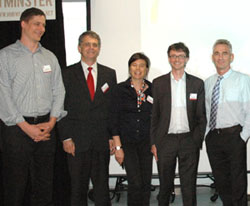 A number of scientific papers deal with sustainable consumption in general and with the issues of nutrition, housing and mobility in particular. The indebtedness of households and the investment of private savings have rarely been discussed in the context of sustainable consumption, although they represent an important aspect of consumer behavior. The RESPONDER workshop on "The Role of Household Savings and Debts in a Sustainable Economy" aimed at closing this gap that was held on 24-25 May 2012 in London. A number of scientific papers deal with sustainable consumption in general and with the issues of nutrition, housing and mobility in particular. The indebtedness of households and the investment of private savings have rarely been discussed in the context of sustainable consumption, although they represent an important aspect of consumer behavior. The RESPONDER workshop on "The Role of Household Savings and Debts in a Sustainable Economy" aimed at closing this gap that was held on 24-25 May 2012 in London.
Tim Jackson (University of Surrey) who celebrated European-wide success with his book "Prosperity without Growth" referred to the European financial and economic crisis in his opening speech: especially in difficult economic times, households tend to limit consumption spending and create savings to be prepared for more difficult times. Households in Great Britain are being asked not do so, but to stimulate the economy through consumer spending. Jackson pointed to an alternative that through renovation and insulation of houses could create jobs and reduce future energy costs at the same time.
James Vaccaro from the "Global Alliance for Banking on Values" showed a new trend in banking: while most banks hardly inform about the companies they give credits to, some British banks offer exactly this information. Who invests money in these banks can track in which companies it is invested. "Many people want to know exactly where their food comes from. For them, it will soon be as important to know in which companies their savings are invested. We provide full transparency”, is he convinced to have found a growing niche market.
Richard Werner from the University of Southampton emphasized the role of banks to finance small and medium-sized companies. He criticized the creation of money by banks and the high proportion of speculative transactions in international banking and demanded that British banks focus more on the real economy. Using examples from Germany and Japan, he showed that a banking system having a large number of small banks have a higher level of stability.
A documentation of this event is available at: http://www.scp-responder.eu/community/documentation/KB_Savings_2012
Green ICT for Growth and Sustainability?
30 May-1 June 2012, Vienna (Austria)
 Information and communication technologies (ICTs) have not only changed our daily lives, they are often regarded as the area that can provide growth and employment in Europe. But are these hopes justified? Can Cloud Computing and Smart Metering contribute to a decoupling of economic growth, energy consumption and resource consumption? Or do new problems arise from consumer electronics and the integration of ICT in everyday consumption practices? These were the key questions of the RESPONDER knowledge brokerage event on "Green ICT for Growth and Sustainability?" held from 30 May to 1 June 2012 in Vienna. Information and communication technologies (ICTs) have not only changed our daily lives, they are often regarded as the area that can provide growth and employment in Europe. But are these hopes justified? Can Cloud Computing and Smart Metering contribute to a decoupling of economic growth, energy consumption and resource consumption? Or do new problems arise from consumer electronics and the integration of ICT in everyday consumption practices? These were the key questions of the RESPONDER knowledge brokerage event on "Green ICT for Growth and Sustainability?" held from 30 May to 1 June 2012 in Vienna.
In her opening speech, Inge Røpke (Technical University of Denmark) underlined that the question was not whether ICT was good or bad for the environment, but how ICT could be used to contribute to sustainable development. In her opinion, improving energy efficiency is not sufficient since the needs of consumers are continuously increasing and the efficiency gains are over-compensating the additional consumption.
Peter Johnston (European Policy Center & Club of Rome) pointed out the enormous opportunities that result from an increased use of ICT for sustainable development, such as indicating climate impacts on every purchase decision.
Lorenz Hilty (University of Zurich & Empa) used two examples to demonstrate that the use of ICT does not always lead to lower environmental impact: while participating in virtual conferences leads to an absolute reduction of CO2 emissions even at a significantly higher number of participants, improving the energy consumption of vending machines led to their increased use also in smaller office, with the volume growth offsetting the energy savings again.
In the framework of a working group, the impact of Cloud Computing on energy consumption and the use of renewable energy sources were discussed, existing knowledge was exchanged and future research needs were drafted. System mapping was used as a participatory methodology with great success. The participants agreed to continue their work in July.
A documentation of this event is available at: http://www.scp-responder.eu/community/documentation/KB_ICT_2012 |
|
|
|
|
|